
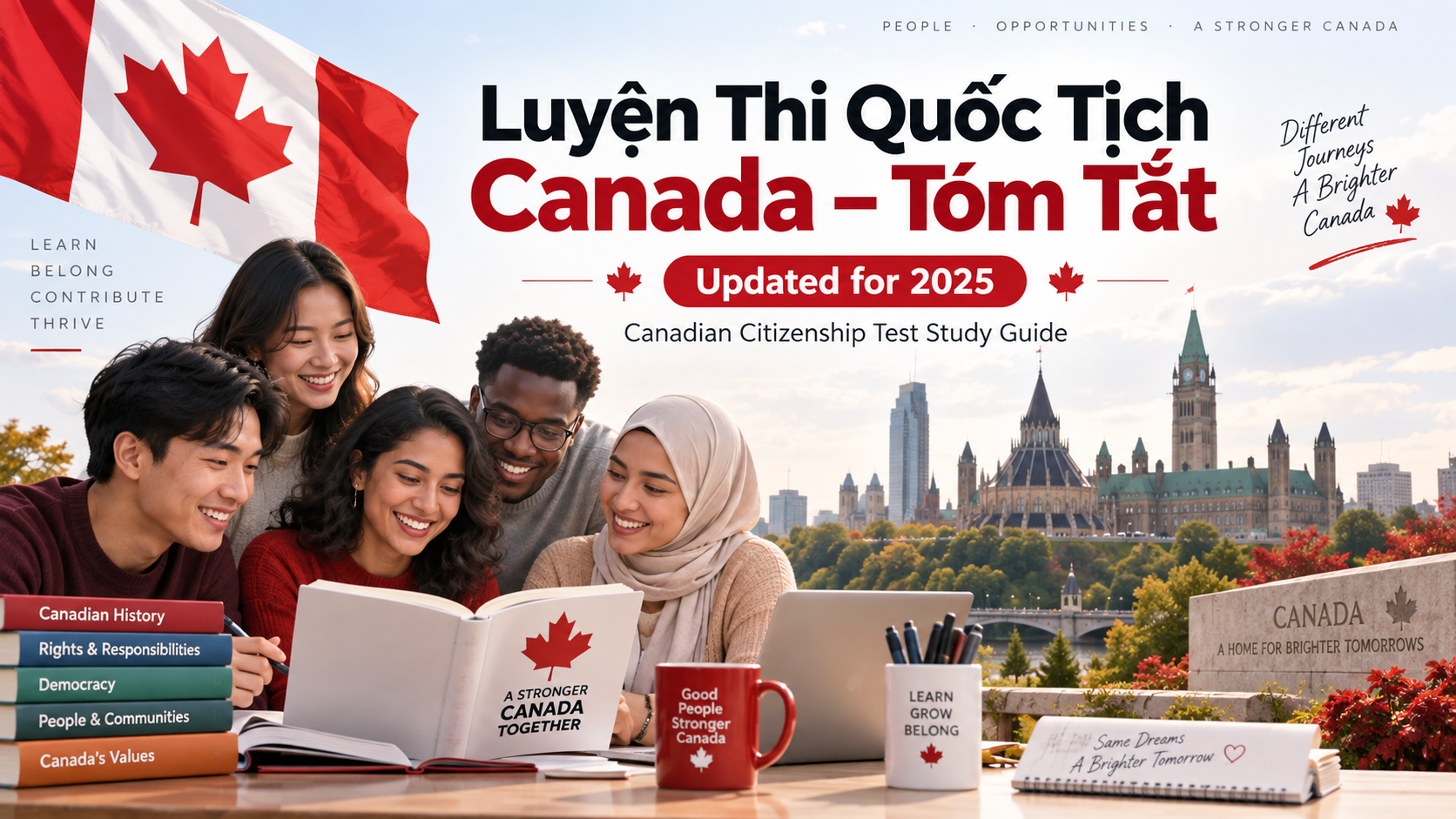
Updated for 2025
Citizenship Test Preparation - Summary (Discover Canada)
I. Canada's Population (2025)
- An estimated 41 million people.
Estimated ~41 million people. - The population continues to grow thanks to immigration and the natural birth rate.
Continues to grow through immigration and natural increase. - It is one of the most multicultural and diverse countries in the world.
One of the world's most multicultural and diverse nations.
II. Introduction
- The origins of Canadian law: The federal parliament, provincial legislatures, English ordinary law, the French civil code, and the unwritten constitution of the United Kingdom.
Sources of Canadian Law: Parliament and provincial legislatures, English common law, the civil code of France, and the unwritten British constitution. - Synthesize the above legal sources: Magna Carta / The Great Charter of Liberty (1215).
Combined all above: Magna Carta / Great Charter of Freedoms (1215 AD). - Habeas CorpusThe right to request a trial for unlawful arrest (under English common law).
Habeas corpus: Right to challenge unlawful detention by the state (English Common Law). - Canadian Constitution: Amended to supplement the Charter of Rights and Freedoms of Canada (1982).
Constitution of Canada: Amended to include the Canadian Charter of Rights and Freedoms (1982). - Fundamental freedoms + Additional rights: Rights of movement, rights of indigenous peoples, the right to official languages and the right to education in minority languages, multicultural policy.
Fundamental freedoms + Additional rights: Mobility rights, Aboriginal Peoples' Rights, Official Language Rights and Minority Language Educational Rights, Multiculturalism. - ResponsibilityTo abide by the law, be responsible to oneself and one's family, participate in juries, vote, volunteer, protect and enjoy heritage and the environment.
Responsibilities: Obey the law, take responsibility for oneself and one's family, serve on a jury, vote, volunteer, protect/enjoy heritage and environment. - Protect CanadaVisit forces.ca and cadets.ca to learn about opportunities for young people (the cadets program now includes cybersecurity and drone operations).
Defending Canada: Visit forces.ca and cadets.ca for youth opportunities (cadets now include cybersecurity and drone activities).
III. History
- British North America Act (1867): “Peace, Order and Good Government”.
British North America Act (1867): “Peace, Order, and Good Government”. - Musicians call Canada the "Great Dominion".
Songwriters called Canada: “Great Dominion”. - Founding peoples: Indigenous peoples, French, English.
Founding peoples: Aboriginal, French, British. - Indigenous people: Migrated from Asia thousands of years ago.
Aboriginal People: Migrated from Asia thousands of years ago. - Royal Decree of 1763: Guaranteeing the territorial rights of Indigenous peoples.
Royal Proclamation of 1763: Guaranteed Aboriginal territorial rights. - Boarding schools (1800–1996): Children were mistreated and their native languages were forbidden.
→ Residential Schools (1800–1996): Children were abused, Aboriginal languages prohibited. - → September 30th has been recognized as the National Day of Truth and Reconciliation since 2021.
→ September 30 recognized as National Day for Truth and Reconciliation since 2021. - Indigenous groups: First Nations (65%), Métis (30%), Inuit (4%).
Aboriginal People Groups: First Nations (65%), Métis (30%), Inuit (4%). - The term “Indian”: Now only has historical/legal significance (Indian Act); currently used is “First Nations”.
‘'Indian' term: Now historical/legal only (Indian Act); preferred term is First Nations. - Currently: Approximately half of the First Nations live in reserves (~600 communities), while the rest live in cities.
First Nations today: About half live on reserves (~600 communities), others in cities. - Inuit: Meaning "People"; they live in the Arctic regions.
Inuit: Meaning “The People”; live in Arctic regions. - Métis: Mixed race between indigenous people and Europeans; speaks Michif.
Métis: Mixed Indigenous and European ancestry; speak Michif. - John Buchan (Lord Tweedsmuir): Supporters of cultural diversity among immigrants.
John Buchan (Lord Tweedsmuir): Promoted immigrant cultural individuality. - Current population: English speakers ~18 million, French speakers ~7 million (mostly in Quebec, some in Ontario, New Brunswick, Manitoba).
Current Population: Anglophones ~18M, Francophones ~7M (mostly Quebec, some in Ontario, NB, Manitoba). - New Brunswick: The only province with an official bilingual system.
New Brunswick: Only official bilingual province. - The Acadians: Descendants of the French; expelled during the “Great Exodus” (1755–1763).
Acadians: French descendants; Great Upheaval deportation (1755–1763). - Quebecois: The majority speak French; the Quebecois ethnic group is recognized (2006).
Quebecers: French-speaking majority; Quebecois nation recognized (2006). - Anglo-Quebec people: Approximately 1 million; play an active role in Quebec society.
Anglo-Quebecers: 1M strong; vibrant part of Quebec society. - The English-speaking way of life: Introduced by the English, Welsh, Scottish, and Irish.
English-speaking way of life: Brought by English, Welsh, Scottish, Irish settlers. - Canada: “The land of immigrants.”.
Canada: “Land of immigrants”. - Immigration trends: Since the 1970s, immigration has been primarily from Asia; currently, it is more prevalent from India, China, the Philippines, Nigeria, and Syria.
Immigration trends: Since 1970s mainly from Asia; now strong immigration from India, China, Philippines, Nigeria, Syria. - Language of residence: Mandarin Chinese is currently the second most spoken language in Vancouver and Toronto.
Languages at home: Mandarin is now second most spoken in Vancouver and Toronto. - Religious diversity: The majority are Christians, but there are also Muslims, Sikhs, Hindus, Jews, and Buddhists.
Religious Diversity: Majority Christians, but includes Muslims, Sikhs, Hindus, Jews, Buddhists. - LGBTQ+ rights: Protected under Canadian law, including the right to marry.
LGBTQ+ Rights: Protected under Canadian law, including marriage. - Early Farmers and Hunters
Early Farmers and Hunters
- The Huron-Wendat and Iroquois people: They practiced farming and hunting in the Great Lakes region.
Huron-Wendat and Iroquois: Farmers/hunters in the Great Lakes region. - The Cree and Dene people: Live by hunting and gathering in the north.
Cree and Dene: Hunter-gatherers in the North. - The Sioux people: They live a nomadic life, following their herds of bison.
Sioux: Nomadic, followed bison herds. - The Inuit: They live off the wildlife of the Arctic.
Inuit: Lived off Arctic wildlife. - Indigenous people on the West Coast: Preserve fish by drying and smoking.
West Coast Aboriginals: Preserved fish by drying and smoking.
European Contact
- In 1497, John Cabot drew a map of the East Coast of Canada.
1497: John Cabot mapped East Coast. - 1534–1542: Jacques Cartier discovered the St. Lawrence River.
1534–1542: Jacques Cartier explored St. Lawrence. - The word "Kanata" in the Iroquoian language means village.
“Kanata” means village in Iroquoian.
French Settlement
- In 1608, Samuel de Champlain founded the city of Quebec.
1608: Samuel de Champlain founded Quebec City. - 1701: Peace treaty signed with the Iroquois.
1701: Peace with the Iroquois. - The fur trade: An economic foundation, with a high demand for beaver skins in Europe.
Fur trade: Central economy; beaver pelts in high demand.
British Conquest
- 1759: Battle of the Plains of Abraham — the British defeated the French; both commanding generals (Wolfe and Montcalm) were killed in action.
1759: Battle of the Plains of Abraham — British defeated French; both generals died (Wolfe and Montcalm). - 1763: The Treaty of Paris; New France is ceded to Great Britain.
1763: Treaty of Paris; New France ceded to Britain.
Quebec Act (1774)
- Protecting religious freedom for Catholics.
Protected Catholic religious rights. - Retain French civil law (criminal law follows the English system).
Maintained French civil law (British-based criminal law).
American Revolution
- In 1776: The 13 colonies separated to form the United States.
1776: 13 colonies broke away to form the United States. - Loyalists, loyal to the British, fled to Canada (Nova Scotia, Quebec).
Loyalists fled to Canada (Nova Scotia, Quebec). - Joseph Brant: Mohawk leader, who spearheaded the Loyalist migration.
Joseph Brant: Mohawk leader; led Loyalist migration. - Black Loyalists: Many settled in Nova Scotia; some later established freetowns in Sierra Leone.
Black Loyalists: Many settled in Nova Scotia; some later established Freetown in Sierra Leone.
Early Legislative Assemblies
- Halifax (1758), Prince Edward Island (1773), New Brunswick (1785).
Halifax (1758), PEI (1773), NB (1785).
Constitutional Act (1791)
- The province of Quebec is divided into Upper Canada (Ontario) and Lower Canada (Quebec).
Split Quebec into Upper (Ontario) and Lower (Quebec) Canada. - Introducing the system of democratically elected legislative bodies.
Introduced elected legislative assemblies.
Upper Canada (Ontario)
- Towards the abolition of slavery (1793).
Moved towards abolition of slavery (1793).
Abolition of slavery
- 1807: The slave trade was banned.
1807: Slave trade banned. - 1833: Slavery was abolished throughout the British Empire.
1833: Slavery abolished throughout Empire.
Underground Railroad
- Thousands of slaves escaped to Canada.
Thousands of escaped slaves reached Canada.
Trading Centers
- Fort Garry (Winnipeg) and Fort Langley (Vancouver).
Fort Garry (Winnipeg) and Fort Langley (Vancouver): Trading centers. - Montreal Stock Exchange: Established in 1832.
Montreal Stock Exchange: Founded in 1832.
War of 1812
- Canadian troops and their Native American allies defeated the American invasions.
Canadian forces, Indigenous allies defeated American invasions. - Major General Isaac Brock was killed in action at Queenston Heights.
Major-General Isaac Brock died at Queenston Heights. - Laura Secord warned Canadian troops about the American attack at Beaver Dams.
Laura Secord warned of American attack at Beaver Dams.
Rideau Canal
- Built to defend against the threat of attack from the United States.
Built to defend against US attacks.
Lord Durham Report
- The proposal suggests that the government should take responsibility and integrate Upper and Lower Canada.
Recommended responsible government and union of Upper/Lower Canada.
Province of Canada/ Province of Canada
- Formed in 1840 by merging Upper and Lower Canada.
Formed in 1840 (united Upper and Lower).
La Fontaine and Baldwin
- Achieving responsible government (1848–1849).
Achieved responsible government (1848–49).
Confederation
- In 1867, Ontario, Quebec, New Brunswick, and Nova Scotia formed the Dominion of Canada.
1867: Ontario, Quebec, New Brunswick, Nova Scotia formed Dominion of Canada. - July 1st became Canada Day (formerly known as "Dominion Day").
July 1st = Canada Day (formerly “Dominion Day”).
Provinces joining the Confederation
- 1870: Manitoba, Northwest Territories.
1870: Manitoba, Northwest Territories. - 1871: British Columbia.
1871: British Columbia. - 1873: Prince Edward Island.
1873: Prince Edward Island. - 1880: The Arctic Islands.
1880: Arctic Islands. - 1898: Yukon.
1898: Yukon. - 1905: Alberta, Saskatchewan.
1905: Alberta, Saskatchewan. - 1949: Newfoundland and Labrador.
1949: Newfoundland and Labrador. - 1999: Nunavut.
1999: Nunavut.
Sir John A. Macdonald/ Sir John A. Macdonald
- Canada's first Prime Minister.
First Prime Minister of Canada.
Sir George-Étienne Cartier/ Sir George-Étienne Cartier
- The chief architect of Quebec's accession to the Federation.
Quebec's Confederation architect.
Louis Riel
- Red River resistance leader.
Led Red River Resistance. - Considered the founding father of the province of Manitoba.
Father of Manitoba.
Gabriel Dumont/ Gabriel Dumont
- Métis' greatest military leader.
Métis military leader.
Sir Sam Steele
- Royal Canadian Mounted Police and Canadian border heroes.
Mountain and soldier.
Canadian Pacific Railway
- Completed in 1885; connecting the East and West.
Completed in 1885; connected East and West.
Chinese Workers
- He made a huge contribution to the construction of the CPR Railway; but suffered from discrimination (Head Tax).
Contributed heavily to CPR; faced discrimination (Head Tax). - The Canadian government officially apologized in 2006.
Apology issued by Canadian Government in 2006.
Sir Wilfrid Laurier/ Sir Wilfrid Laurier
- Canada's first Prime Minister of French descent.
First French-Canadian Prime Minister.
Boer War (1899–1902)
- Over 7,000 Canadian soldiers fought in South Africa.
Over 7,000 Canadians served in the Boer War in South Africa.
World War I
- Vimy Ridge (1917): A crucial victory for Canada.
Vimy Ridge (1917): Key Canadian victory. - April 9th is known as Vimy Day.
April 9 = Vimy Day. - General Arthur Currie: Commander of the Canadian Army Corps.
General Arthur Currie: Canadian Corps commander. - 60,000 Canadians were killed; 170,000 were injured.
60,000 Canadians killed; 170,000 wounded.
Women's Suffrage Movement
- 1918: Most women aged 21 and older were granted the right to vote in federal elections.
1918: Most women 21+ were granted federal voting rights. - 1940: Quebec allows women to vote.
1940: Quebec granted women the vote.
World War II
- D-Day (1944): Canadian forces captured Juno Beach.
D-Day (1944): Canadians captured Juno Beach. - Royal Canadian Air Force (RCAF): Actively participates in the Commonwealth.
RCAF: High Commonwealth participation. - Royal Canadian Navy (RCN): Played a crucial role in the Battle of the Atlantic.
RCN: Vital in Battle of Atlantic.
Holocaust Refugees
- Canada has rejected many Jewish refugees — a fact it later acknowledged and expressed regret over.
Canada turned away many Holocaust refugees; later acknowledged with regret.
Post-War Developments
- Oil was discovered in Alberta (1947).
Discovery of oil (Alberta 1947). - Unemployment insurance was established (1940).
Unemployment Insurance (1940). - The Canada Health Act was enacted.
Canada Health Act. - The Old Age Security Program (1927) and CPP/QPP (1965) were established.
Old Age Security (1927) and CPP/QPP (1965).
International Alliances
- Canada joined NATO.
Canada joined NATO. - NORAD: Canadian-United States Space Defense System.
NORAD (Canada-US air defense).
The Quiet Revolution
- The 1960s in Quebec: Modernization and Secularization of Society.
Quiet Revolution (1960s): Quebec modernization and secularization.
Royal Commission on Bilingualism and Biculturalism
- This led to the enactment of the Official Languages Act of 1969.
Led to the 1969 Official Languages Act.
La Francophonie
- Founded in 1970, it connects French-speaking countries.
Founded in 1970 (association of French-speaking nations).
Quebec Referendums
- 1980 and 1995: Both failed, and Quebec remained part of Canada.
1980 and 1995: Both referendums defeated, Quebec remained in Canada.
IV. Notable Canadian Figures
- Writers/Poets: Stephen Leacock, Louis Hémon, Sir Charles GD Roberts, Pauline Johnson, Émile Nelligan, Robertson Davies, Margaret Laurence, and Mordecai Richler.
Novelists / Poets: Stephen Leacock, Louis Hémon, Sir Charles GD Roberts, Pauline Johnson, Émile Nelligan, Robertson Davies, Margaret Laurence and Mordecai Richler. - Modern writers: Joy Kogawa, Michael Ondaatje, Rohinton Mistry.
Modern Writers: Joy Kogawa, Michael Ondaatje, Rohinton Mistry. - The composers were Sir Ernest MacMillan and Healey Willan.
Musicians: Sir Ernest MacMillan and Healey Willan. - The Group of Seven (1920): Pioneers in the art of painting unspoiled landscapes.
Group of Seven (1920): Landscape painting pioneers. - Emily Carr: Drawings of forests and artifacts of the West Coast Indigenous people.
Emily Carr: Painted forests and Indigenous artifacts of the West Coast. - Les Automatistses: A group of pioneering abstract artists in Quebec (Jean-Paul Riopelle being the most prominent).
Les Automatistes: Abstract artists (Jean-Paul Riopelle notable). - Louis-Philippe Hébert: A renowned sculptor known for his historical works.
Louis-Philippe Hébert: Sculptor of historical figures. - Kenojuak Ashevak: An Inuit artist famous for his rock carvings and prints.
Kenojuak Ashevak: Inuit artist (etchings and soapstone carvings). - Filmmakers: Denys Arcand, Norman Jewison, Atom Egoyan.
Filmmakers: Denys Arcand, Norman Jewison, Atom Egoyan. - The thinkers: Marshall McLuhan, Harold Innis.
Thinkers: Marshall McLuhan, Harold Innis.
Sports and Personal Achievements
- James Naismith: Invented basketball in 1891.
James Naismith: Invented basketball in 1891. - Donovan Bailey: World champion track and field athlete and two-time Olympic gold medalist.
Donovan Bailey: World record sprinter and double Olympic gold medallist. - Chantal Petitclerc: World wheelchair racing champion and Paralympic gold medalist.
Chantal Petitclerc: World champion wheelchair racer and Paralympic gold medallist. - Wayne Gretzky: One of the greatest hockey players in history.
Wayne Gretzky: One of the greatest hockey players of all time. - Catriona Le May Doan: Gold medalist in speed skating at the 2002 Winter Olympics.
Catriona Le May Doan: Gold medalist in speed skating at the 2002 Winter Olympics. - Terry Fox: Lost a leg to cancer; ran across Canada to raise funds for cancer research (Marathon of Hope).
Terry Fox: Lost a leg to cancer; ran the “Marathon of Hope” across Canada for cancer research. - Rick Hansen: Traveling around the world in a wheelchair to raise funds for spinal cord injury research.
Rick Hansen: Circled the globe in a wheelchair to raise funds for spinal cord research.
Nobel Prize-winning scientists
- Gerhard Herzberg, John Polanyi, Sidney Altman, Richard E. Taylor, Michael Smith and Bertram Brockhouse.
Gerhard Herzberg, John Polanyi, Sidney Altman, Richard E. Taylor, Michael Smith and Bertram Brockhouse.
V. Government of Canada
Political system Political System
Canada is a federal country, a parliamentary democracy, and a constitutional monarchy.
Canada is a Federal State, a Parliamentary Democracy, and a Constitutional Monarchy.
• The federal government is responsible for national and international affairs (defense, foreign affairs, interstate trade, currency, criminal law, and nationality).
Federal government: Matters of national and international concerns (defense, foreign policy, interprovincial trade, currency, criminal law, citizenship).
• Provincial governments manage education, healthcare, natural resources, property and civil rights, and highways.
Provincial Government: Education, health, natural resources, property and civil rights, highways.
• Federal and provincial governments share responsibility for agriculture and immigration.
Federal and provincial governments share jurisdiction over agriculture and immigration.
Canadian Parliament Parliament of Canada
• Parliament consists of three parts: the monarch (King Charles III), the Senate, and the House of Representatives.
Parliament consists of three parts: the Sovereign (King Charles III), the Senate, and the House of Commons.
• Provinces have their own legislative bodies, including a Deputy Governor-General and an elected Legislative Council.
Provincial legislatures consist of the Lieutenant Governor and the elected Assembly.
• The Prime Minister selects the ministers and is responsible for running the government.
Prime Minister selects Cabinet ministers and manages government operations.
• Members of the House of Representatives are elected for a maximum term of four years.
Members of Parliament are elected for a maximum of four years.
• Senators are appointed upon the recommendation of the Prime Minister and serve until the age of 75.
Senators are appointed on the advice of the Prime Minister and serve until age 75.
• The bill must pass both houses and be approved by the Governor-General before it can become law.
No bill becomes law until passed by both Houses and receives Royal Assent.
The legislative process (How a bill becomes law) Legislative Process (How a Bill Becomes Law)
• Step 1: Initial Submission — Read and Print.
STEP 1: First Reading — The bill is considered read for the first time and printed.
• Step 2: Second submission — Debate on the principles of the bill.
STEP 2: Second Reading — Members debate the bill's principle.
• Step 3: Committee Phase — Studying each clause.
STEP 3: Committee Stage — Study the bill clause by clause.
• Step 4: Reporting Phase — Further modifications are possible.
STEP 4: Report Stage — Members can make amendments.
• Step 5: Third Submission — Final Debate and Voting.
STEP 5: Third Reading — Final debate and vote.
• Step 6: Senate — Review the same bill.
STEP 6: Senate — Bill follows similar process.
• Step 7: Royal Approval — Becomes Law.
STEP 7: Royal Assent — Bill becomes law.
Constitutional monarchy Constitutional Monarchy
• The head of state is King Charles III, represented by a Governor-General at the federal level and Deputy Governor-General at the state level.
The Head of State is King Charles III, represented by the Governor General federally and Lieutenant Governors provincially.
• The positions of Governor-General and Deputy Governor-General are appointed upon the recommendation of the Prime Minister for a five-year term.
Governors are appointed on the Prime Minister's advice for 5-year terms.
Three branches of government Three Branches of Government
• Executive, legislative, and judicial branches.
Executive, Legislative, and Judicial.
• Members of the legislature are referred to as MLA, MNA, MPP, or MHA depending on the province.
Legislators are called MLAs, MNAs, MPPs, or MHAs depending on the province.
• Premier: The head of the provincial government.
Premier: Head of provincial government.
• The territories are represented by Commissioners.
Territories have Commissioners with ceremonial roles.
Local government Municipal Government
• Headed by the Mayor or the Precinct President (Reeve); the City Council is responsible for traffic, fire safety, public security, etc.
Led by Mayors or Reeves; city councils manage snow removal, firefighting, policing, etc.
• Indigenous communities have Chiefs and tribal councils that manage the reserve.
First Nations have chiefs and band councils managing reserves.
VI. Elections in Canada Elections in Canada
• Federal general elections are held every four years on the third Monday of October.
Federal elections are held every four years on the third Monday of October.
Canadian citizens aged 18 and over are eligible to vote.
Canadian citizens aged 18 and older can vote.
• The ballots are completely confidential.
Voting is secret.
• A voter information card and identification documents are required when voting.
Bring voter information card and ID when voting.
• Voting can be done in advance (advance poll) or by mail (special ballot).
You can vote at advance polls or by special ballot.
• Congress has 338 electoral districts (ridings).
There are 338 electoral districts (ridings).
• The party with the most seats will form the government.
The party with the most seats forms the government.
• If the ruling party has fewer than 50% seats: Minority government.
If ruling party holds less than 50% of seats: Minority government.
• If the government fails in a crucial vote, it must request the dissolution of Parliament and the holding of new elections.
If defeated on a major vote, the Prime Minister requests a new election.
VII. The Judicial System Justice System
• Fundamental principle: Innocent until proven guilty.
Presumption of innocence until proven guilty.
• Courts resolve disputes; police enforce the law.
Courts settle disputes; police enforce the law.
• The law applies to everyone, including politicians and police officers.
The law applies equally to everyone, including politicians and police.
• The Supreme Court of Canada is the highest court.
The Supreme Court of Canada is the highest court.
• The Canadian Federal Courts hear cases involving the federal government.
Federal Court deals with federal matters.
Each province has both a first-instance court and an appellate court.
Each province has trial and appeal courts.
• In addition, there are: family courts, traffic courts, and small civil courts.
Other courts: Family, Traffic, and Small Claims Courts.
VIII. Police in Canada police in Canada
• The RCMP (Royal Canadian Mounted Police) enforces federal law nationwide, except for Ontario and Quebec (which have their own provincial police forces).
The RCMP enforces federal laws nationally except in Ontario and Quebec.
• You can request police assistance or file a complaint if necessary.
You can ask police for help or file complaints if needed.
• Free or low-cost legal aid services are available if you cannot afford to hire a lawyer.
Legal aid is available if you cannot afford a lawyer.
IX. Symbols of Canada Symbols of Canada
Crown/ The Crown
The crown has been a symbol of the Canadian state for over 400 years.
The Crown has been a symbol of the Canadian state for over 400 years.
• Represents the government, courts, police force, and military.
It represents the government, courts, police, and Canadian Forces.
• Current monarch: Charles III.
Current Sovereign: King Charles III.
Canadian flag National Flag of Canada
• Officially launched in 1965.
Adopted in 1965.
• The flag features a red maple leaf on a white background with two red stripes on either side.
Features a red maple leaf on a white background with two red borders.
• Red and white have been chosen as the national colors since 1921.
Red and white have been Canada's national colors since 1921.
Royal flag Royal Flag
• The Union Jack remains the official royal flag of Canada.
The Union Jack remains Canada's official Royal Flag.
Maple leaf Maple Leaf
• It is the most famous symbol of Canada.
The maple leaf is Canada's most famous symbol.
• Appears on flags, uniforms, and soldiers' tombstones.
Appears on the national flag, military uniforms, and soldiers' graves.
Lily Fleur-de-Lys
• A symbol of the French royal family for over 1,000 years.
Symbol of French royalty for more than a thousand years.
• Used during the New France period.
Used in the colony of New France.
Quebec officially adopted the Fleurdelisé flag in 1948.
Quebec adopted the Fleurdelisé flag in 1948.
National emblem and motto Coat of Arms and Motto
• The national emblem reflects the Anglo-French heritage.
The Coat of Arms reflects British and French heritage.
• Motto: “A Mari Usque Ad Mare” (“From sea to sea”).
Motto: “A Mari Usque Ad Mare” (“From Sea to Sea”).
Parliament building Parliament Buildings
• Completed in the 1860s.
Completed in the 1860s.
• The central part of the building burned down in 1916 and was rebuilt in 1922.
Center Block destroyed by fire in 1916; rebuilt in 1922.
• The Peace Tower was completed in 1927 to commemorate soldiers of World War I.
The Peace Tower was completed in 1927 to honor WWI soldiers.
• The Memorial Room contains a book listing the names of fallen soldiers.
The Memorial Chamber holds the Books of Remembrance.
Architecture of the Provincial Legislative Buildings Provincial Legislature Architecture
• The majority are in the Baroque, Romanesque, or Neoclassical style, reflecting the democratic heritage of Greco-Roman civilization.
Most legislatures are Baroque, Romanesque, or Neoclassical, reflecting Greco-Roman democracy.
• The Quebec Parliament building is in the style of the Second French Empire.
Quebec's National Assembly was built in the French Second Empire style.
National Sports National Sports
• Hockey is the national winter sport.
Hockey is the national winter sport.
• Lacrosse is the national summer sport.
Lacrosse is the national summer sport.
• Stanley Cup: Awarded to the NHL champion team since 1892.
Stanley Cup: Awarded to NHL champions since 1892.
• Clarkson's Cup: Awarded to the Canadian women's hockey champion team since 2005.
Clarkson Cup: Awarded to women's hockey champions since 2005.
• Football currently has the largest number of registered players.
Soccer has the highest number of registered players in Canada.
Castor/ The Beaver
• An icon from the Hudson's Bay Company era.
Adopted by Hudson's Bay Company centuries ago.
• Appears on the 5-cent coin, the national emblems of Saskatchewan and Alberta, and the city coats of arms of Montreal and Toronto.
Appears on the 5-cent coin, Saskatchewan and Alberta coats of arms, and Montreal and Toronto crests.
Official Language Act Official Languages Act (1969)
• Establish equality between English and French in the federal government.
Established equality between English and French in the federal government.
• Protecting minority communities whose official language is not a national language.
Protects official language minority communities.
Canadian national anthem National Anthem
• “O Canada” became the official national anthem in 1980.
“O Canada” became the official national anthem in 1980.
The song was first sung in French in Quebec City in 1880.
First sung in French in Quebec City in 1880.
Royal Anthem Royal Anthem
• “God Save the King” is used in royal events.
“God Save the King” is used at royal events.
Victoria Medal The Victoria Cross
• Canada's highest military honor.
Canada's highest military honor.
• Reward outstanding acts of courage in the face of the enemy.
Awarded for most conspicuous bravery in the presence of the enemy.
X. National Public Holidays and Important Dates
• New Year's Day — January 1st
New Year's Day — January 1
• Sir John A. Macdonald Day — January 11
Sir John A. Macdonald Day — January 11
• Canada Flag Day — February 15
National Flag of Canada Day — February 15
• Good Friday — The Friday before Easter Sunday
Good Friday — Friday before Easter Sunday
• Easter Monday — The Monday after Easter Sunday
Easter Monday — Monday after Easter Sunday
Vimy Day — April 9th
Vimy Day — April 9
• Victoria Day — The Monday before May 25th
Victoria Day — Monday before May 25 (Sovereign's Birthday)
• National Fête Day (Quebec) — June 24 (Feast of Saint John the Baptist)
Fête Nationale (Quebec) — June 24 (Feast of St. John the Baptist)
Canada Day — July 1st
Canada Day — July 1
• Labor Day — The first Monday of September
Labor Day — First Monday of September
• Thanksgiving — The second Monday of October
Thanksgiving Day — Second Monday of October
• Remembrance Day — November 11
Remembrance Day — November 11
• Sir Wilfrid Laurier Day — November 20th
Sir Wilfrid Laurier Day — November 20
• Christmas Day — December 25th
Christmas Day — December 25
• Boxing Day — December 26
Boxing Day — December 26
XI. The Canadian Economy Economy of Canada
• In 1988, Canada signed the North American Free Trade Agreement (NAFTA) with the United States; Mexico joined in 1994.
In 1988, Canada signed the North American Free Trade Agreement (NAFTA) with the US; Mexico joined in 1994.
• Three main economic sectors: Services (accounting for 751% of total GDP), Manufacturing, and Natural Resources.
Three main industries: Service (75%), Manufacturing, Natural Resources.
• Largest trading partner: United States.
Largest trading partner: United States.
Canada and the United States have the longest undefended international borders in the world.
Canada and the US share the world's longest undefended border.
• Over 751 TP3T of Canadian exports went to the United States.
Over 75% of Canadian exports go to the United States.
• The Peace Arch bears the inscriptions: “Children of a common mother” and “Brethren dwelling together in unity”.
The Peace Arch bears the inscriptions: “Children of a common mother” and “Brethren dwelling together in unity”.
XII. Regions of Canada Regions of Canada
Geographic regions Geographic Regions
• Major regions of Canada:
Main regions of Canada:
- Atlantic Provinces
Atlantic Provinces - Central Canada
Central Canada - Prairie Provinces
Prairie Provinces - West Coast
The Blue Coast - Northern Territories
Northern Territories
• National Capital Region (NCR): Ottawa, situated on the Ottawa River.
National Capital Region (NCR): Ottawa, located on the Ottawa River.
• Ottawa is Canada's fourth-largest metropolitan area (~4,700 km²).
Ottawa is the fourth largest metropolitan area in Canada (~4,700 sq. km).
Canada has 10 provinces and 3 territories.
Canada has 10 provinces and 3 territories.
• Population of Canada in 2025: Approximately 41 million people.
Canada's population in 2025: About 41 million people.
Atlantic Provinces Atlantic Provinces
1. Newfoundland and Labrador
• The easternmost point of North America.
Most easterly point in North America.
• It has its own time zone.
It has its own time zone.
• The oldest colony of the British Empire.
Oldest colony of the British Empire.
• Traditional fishing, offshore oil and gas exploration, and hydroelectric power in Labrador.
Traditional accommodation, offshore oil and gas, hydrogen resources in Labrador.
2. Prince Edward Island
• Canada's smallest province.
Smallest province.
• Famous for its beaches, red soil, and agriculture (potatoes).
Famous for beaches, red soil, agriculture (potatoes).
• The birthplace of the Confederation.
Birthplace of Confederation.
• Connected to the mainland by the Confederation Bridge.
Connected to mainland by Confederation Bridge.
3. Nova Scotia
• The most populous province in the Atlantic region.
Most populous Atlantic province.
• Halifax Port: The largest seaport on the East Coast and the largest naval base.
Halifax: Largest East Coast port and major naval base.
• Rich Celtic and Gaelic traditions.
Rich Celtic and Gaelic heritage.
4. New Brunswick
• Located in the Appalachian Mountains.
Located in the Appalachian Range.
• Founded by those loyal to the Royal Family.
Founded by United Empire Loyalists.
• The Saint John River system is the second largest river system on the Atlantic coast.
Saint John River system is the second largest river system on the Atlantic coast.
• Saint John is the largest city in the province.
Saint John is the largest city.
• The only province with an official bilingual system.
Only official bilingual province.
Ø Center Canada/ Central Canada
5. Quebec
• Population of approximately 8 million people.
Population about 8 million people.
• The Saint Lawrence River flows through the province.
St. Lawrence River flows through the province.
• Three-quarters of the population uses French as their mother tongue.
Three-quarters of the population speak French as a first language.
• Canada's largest producer of paper and pulp.
Main producer of pulp and paper.
• The largest manufacturer of electro-hydraulics.
Largest producer of hydroelectricity.
• The pharmaceutical and aerospace industries are thriving.
Thriving pharmaceutical and aerospace industries.
• Montreal: The second largest French-speaking city in the world after Paris.
Montreal: Largest French-speaking city after Paris.
Quebec's art and film industries enjoy international prestige.
Quebec's arts and films have international recognition.
6. Ontario
• Population of over 12 million people.
Population over 12 million.
• Toronto: Canada's largest city and the nation's financial center.
Toronto: Largest city and financial center of Canada.
• The majority of the population works in the service or manufacturing sectors.
Most work in services or manufacturing.
• The Niagara region is famous for its vineyards, wine, and fruit trees.
Niagara region known for vineyards, wines, and fruit crops.
• Founded by those loyal to the Royal Family.
Founded by United Empire Loyalists.
Ontario has the largest French-speaking community outside of Quebec.
Ontario has the largest French-speaking population outside Quebec.
• The 5 Great Lakes: Ontario, Erie, Huron, Michigan, Superior.
Five Great Lakes: Ontario, Erie, Huron, Michigan, Superior.
Ø Grassland provinces/ Prairie Provinces
7. Manitoba
• Major industries: Agriculture, mining, hydroelectric power.
Main industries: Agriculture, mining, hydroelectric power.
• Most populous city: Winnipeg.
Most populous city: Winnipeg.
• The most famous intersection: Portage and Main.
Most famous intersection: Portage and Main.
• 141 TP3T of Manitoba residents are of Ukrainian descent, while over 151 TP3T are Indigenous.
14% Ukrainian ancestry, over 15% Indigenous.
8. Saskatchewan
• Once known as the "Breadbasket of the world".
Once called the “Breadbasket of the World”.
• Owns 40% of Canadian agricultural land.
Has 40% of Canada's arable land.
• Canada's largest producer of grains and oilseeds.
Largest producer of grains and oilseeds.
• It has the world's largest reserves of uranium and potassium.
World's richest deposits of uranium and potash.
• Regina: The headquarters and training center of the RCMP.
Regina: Capital and home of RCMP Training Academy.
• Saskatoon: Research, education, and mining center.
Saskatoon: Mining, educational, research and technology centre.
9. Alberta
• The most populous province in the grassland region.
Most populous prairie province.
• Canada's largest oil and gas producer.
Largest oil and gas producer in Canada.
• Lake Louise and the Rocky Mountains are famous.
Famous Lake Louise and the Rocky Mountains.
• The state and lake are named after Princess Louise Caroline Alberta.
Named after Princess Louise Caroline Alberta.
• There are 5 national parks, the most notable being Banff (established in 1885).
Five national parks, including Banff (established 1885).
The Badlands region has the world's richest collection of dinosaur fossils.
Badlands has the world's richest dinosaur fossil beds.
• Famous for its agriculture and beef cattle farming.
Renowned for agriculture and beef ranching.
West Coast of Canada West Coast of Canada
10. British Columbia (BC)
• Canada's westernmost province.
Westernmost province of Canada.
• Population of approximately 4 million people.
Population about 4 million.
• Vancouver Port: A gateway for trade with the Asia-Pacific region.
Port of Vancouver: Gateway to Asia-Pacific trade.
• Half of the province's industrial output comes from forestry (timber, newspaper, pulp).
Half of the goods produced come from forestry (lumber, newsprint, pulp).
• Mining, fishing, fruit farming, and winemaking are also highly developed industries.
Mining, fishing, fruit orchards, and wine industries are also strong.
• BC has over 600 natural parks – the largest park system in Canada.
BC has over 600 parks – the most extensive park system in Canada.
• With a large Asian community, Cantonese and Punjabi are the most widely spoken languages after English.
Large Asian communities; Cantonese and Punjabi are most spoken after English.
• Victoria: The capital of BC, a tourist hub, and a base for the Pacific Fleet of the Navy.
Victoria: Capital city, tourist hub, and headquarters of the Pacific naval fleet.
Northern Territories Northern Territories
11. Yukon
• Famous for the Klondike Gold Rush (1890s).
Known for the Klondike Gold Rush (1890s).
• The White Pass and Yukon Railway has been in operation since 1900.
White Pass and Yukon Railway opened in 1900.
• Operate the route from Alaska to Whitehorse.
Railway operates from Alaska to Whitehorse.
• Record-breaking cold temperature: -63°C (the coldest temperature ever recorded in Canada).
Coldest recorded temperature in Canada: -63°C.
• Mount Logan: Canada's highest mountain.
Mount Logan: Highest mountain in Canada.
The mountain is named after the geologist William Logan.
Named after geologist William Logan.
12. Northwest Territories (NWT)
• Formed from Rupert's Land and the Northwest Territories.
Formed from Rupert's Land and the North-Western Territory.
• Capital city: Yellowknife (~20,000 inhabitants).
Capital: Yellowknife (~20,000 people).
Yellowknife is known as the "Diamond Capital of North America".
Yellowknife is known as the “Diamond Capital of North America.”
• More than half of the population are Indigenous peoples (Dene, Inuit, Métis).
Over half the population is Indigenous (Dene, Inuit, Métis).
• Mackenzie River: The second longest river in North America (after the Mississippi), with a drainage basin area of 1.8 million km².
Mackenzie River: Second longest river in North America, draining 1.8 million km².
13. Nunavut
• Nunavut means "our land" in the Inuktitut language.
Nunavut means “our land” in Inuktitut.
• Established in 1999, it spun off from the Northwest Territories.
Established in 1999, separated from Northwest Territories.
• Capital city: Iqaluit.
Capital: Iqaluit.
• The 19-member Parliament elects the Premier and cabinet by consensus.
Legislative Assembly of 19 members selects the Premier and Cabinet by consensus.
• Approximately 851 TP3T of the population are Inuit.
About 85% of the population is Inuit.
• Inuktitut is the official language and is taught in schools.
Inuktitut is an official language and the primary language in schools.
XIII. Regional Highlights of Canada
§ Newfoundland and Labrador
• Coastal fisheries and offshore oil and gas exploration are the main economic activities.
Coastal fishing and offshore oil and gas industries dominate the economy.
Prince Edward Island
• Famous for its fertile red soil, potatoes, and picturesque scenery.
Known for fertile red soil, potato farming, and beautiful scenery.
§ Nova Scotia
• It has shipbuilding and fishing industries, and Halifax is an important commercial center on the Atlantic coast.
Shipbuilding, fishing, and Halifax as a key Atlantic trade and defense center.
§ New Brunswick
• Saint John is a major industrial city; approximately one-third of its population speaks French.
Saint John is a major industrial city; about one-third of the population is French-speaking.
Quebec
• The economy is based on manufacturing, exploitation of natural resources, and high technology.
Economy based on manufacturing, natural resources, and high technology.
Ontario
• Canada's largest economic and industrial center, with Toronto and Ottawa as key cities.
Canada's largest economic and industrial centre, home to Toronto and Ottawa.
Manitoba
• Agriculture, mining, and hydropower are key sectors.
Key sectors: agriculture, mining, and hydroelectricity.
Saskatchewan
• Known for its fertile agricultural land and the world's largest production of uranium and potassium.
Known for fertile farmland, and world's largest uranium and potash production.
Alberta
• Leading in oil and gas production and agriculture (especially beef cattle farming).
Leading producer of oil, gas, and agriculture (notably cattle ranching).
British Columbia
• Trade with Asia, logging, tourism, and fishing play important roles.
Trade with Asia, forestry, tourism, and fishing are vital industries.
§ Yukon
• The economy is based on mineral extraction, tourism, and government services.
Economy based on mining, tourism, and government services.
Northwest Territories
• Diamond resources, oil and gas, and shipping via the Mackenzie River are very important.
Diamonds, oil and gas, and transportation via the Mackenzie River are key.
§ Nunavut
• Traditional economy: hunting, fishing, and Inuit handicrafts.
Traditional economy: hunting, fishing, and Inuit arts and crafts.
Disclaimer:
This study guide was prepared using materials from the Discover Canada official resource, reputable Internet sources, personal decision.
While every effort has been made to ensure the information is accurate and helpful, I do not guarantee that using this material alone will result in passing the Canadian Citizenship Test. Additionally, although great care has been taken, I do not guarantee the notes are completely free of errors or omissions.
You are encouraged to consult official sources and study thoroughly.
Prepared by: Ton Nguyen– Calgary Realtor
E-mail: contact.tonnguyen@gmail.com | Phone: (403) 473-5555
Good luck with your studies
and your journey towards Canadian citizenship!