

📌 NOTE: The answers to all 108 questions are located at the end of the article. You should try answering the question yourself first, then scroll to the end of the article to check your answer.
Question 1
Unless otherwise posted, what is the basic speed limit outside a city, town or village on a primary highway?
Unless otherwise indicated by signs, what is the basic speed limit on major highways located outside of cities, towns, or villages?
A. 100 km/h
B. 90 km/h
C. 110 km/h
D. 80 km/h
Question 2
When backing a passenger vehicle to the left, a driver should:
When reversing a passenger vehicle to the left, the driver should:
A. Look in the inside rear-view mirror and make steering adjustments as necessary
B. Look over the right shoulder with occasional glances to the front
C. Look over the left shoulder with occasional glances to the front
D. Without shoulder checking, use the inside and outside rear-view mirrors
Question 3
When approaching an intersection and facing a traffic control light that is showing a green right-turn arrow and a red light, a driver:
When approaching an intersection with a green arrow indicating a right turn while the red light is on, the driver should:
A. Must stop and wait for a green light
B. May go straight through without stopping
C. May proceed when safe, without stopping, in the direction of the arrow
D. May turn left without stopping
Question 4
Alberta has a demerit point system where a fully licensed driver is suspended when they accumulate:
Under Alberta's penalty points system, those with a full license can have their license suspended if they accumulate:
A. 15 points
B. 8 points
C. 5 points
D. 12 points
Question 5
When passing a large truck on a two-way highway, a driver should:
When overtaking a large truck on a two-way road, the driver should:
A. Leave extra room before returning to their lane
B. Return when signaled by the truck's headlights
C. Return when the truck is no longer visible in any mirror
D. Return once they have cleared the truck's front bumper
Question 6
Which statement best describes the steps for turning right at a red traffic light?
Which of the following best describes the steps for turning right at a red light?
A. Right turns on red are never permitted
B. Signal, make sure there is no sign prohibiting the turn, stop, look left and right, yield, then proceed
C. Reduce speed, look right, signal and proceed
D. Signal and reduce speed, look left and proceed
Question 7
This sign indicates:
What does this sign mean?
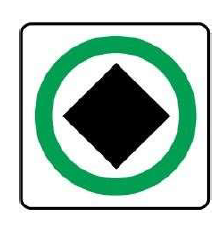
A. Route for vehicles over 4500 kg
B. Route for slow-moving vehicles
C. Reserved lane for buses
D. Dangerous goods route
Question 8
A single solid white line between driving lanes in an urban area means:
A solid white line between lanes in urban areas means:
A. Separates opposite directions of traffic
B. Traffic on the right is moving faster
C. Lane changing is not permitted
D. Lane changing is permitted
Question 9
A “parking lane” as defined in the Basic License Driver's Handbook is:
According to the Driver's Handbook, a "parking lane" is defined as:
A. A lane closest to the curb where parking is permitted
B. All of these responses are correct
C. The portion of a primary highway between the edge of the roadway and nearest solid white line
D. A lane beside parking meters
Question 10
Shoulder checking means:
“"Shoulder check" means:
A. Glancing towards the blind spot in the direction the driver intends to move
B. Glancing into the left outside mirror
C. Glancing into both mirrors
D. Glancing into the right outside mirror
Question 11
This sign indicates:
What does this sign mean?
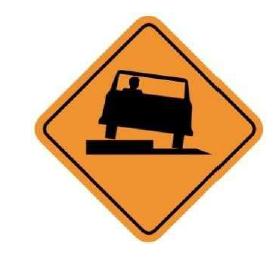
A. Off-road facilities ahead
B. Slippery when wet
C. Uneven each
D. Detour ahead
Question 12
A traffic-lane control light with an illuminated red “X” means:
A red "X" on the lane control light means:
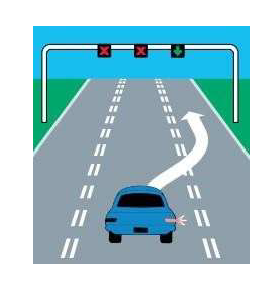
A. Prepare for an emergency vehicle
B. Reduce speed below 30 km/h
C. Use the lane only for left turns
D. Travel is not permitted in that lane
Question 13
Does a parent have the right to withdraw previously given parental consent for someone under 18 regarding an operator's license?
Do parents have the right to withdraw their previously granted consent for a driver's license for someone under 18?
A. Yes, provided the person is still under 18 and is not self-supporting or married
B. Yes, if both parents verbally agree
C. No, consent remains until age 18
D. No, another consent form is required after suspension
Question 14
When approaching a Yield sign, you must:
When you arrive at Yield Beach, you must:
A. Yield the right-of-way to traffic not facing the sign and pedestrians in the intersection
B. Always sound the horn
C. Expect other vehicles to yield to you
D. Always come to a complete stop
Question 15
The term “over-driving” your headlights at night means:
The term "over-driving your headlights" when driving at night means:
A. You cannot see clearly for 1,000 meters
B. The low beams are improperly adjusted
C. You are traveling too fast to see an object in time to stop
D. Your headlights have been on too long
Question 16
Under the Graduated Driver Licensing program, a driver will receive 2 demerits:
According to the Graduated Driver Licensing program, drivers can receive 2 penalty points when:
A. Having more passengers than there are seat belts
B. Not wearing a seat belt securely fastened
C. Not wearing a seat belt
D. Not adjust the seat belt properly
Question 17
Using the 2-second rule to judge a safe following distance when driving:
When using the two-second rule to determine a safe distance from the vehicle in front:
A. It is more accurate on rural highways
B. It is inaccurate above 100 km/h
C. It is accurate at any speed under normal conditions
D. It is inaccurate below 30 km/h
Question 18
This sign indicates:
What does this sign mean?
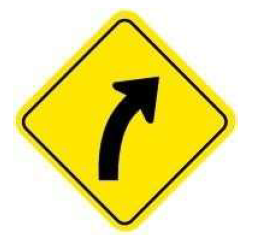
A. Traffic entering from the right
B. Winding road ahead
C. Curve right
D. Concealed intersection on the right
Question 19
A driver approaching a flashing red traffic light must:
When encountering a flashing red traffic light, drivers must:
A. Stop and wait for flashing green
B. Reduce speed and operate
C. Stop and proceed only when safe
D. Wait until the light turns green
Question 20
This sign indicates:
What does this sign mean?
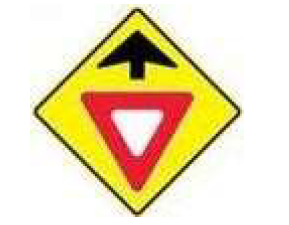
A. Do not enter
B. Slow-moving vehicles ahead
C. Warning – Yield sign ahead
D. Warning – traffic approaching
Question 21
According to Alberta law, it is the driver's responsibility to ensure that all passengers under what age are properly restrained?
According to Alberta law, under what age are drivers responsible for ensuring passengers are properly secured with seat belts?
A. 18 years
B. 24 years
C. 21 years
D. 16 years
Question 22
When parallel parking, the vehicle's wheels closest to the curb must be within what maximum distance?
When parallel parking, what is the maximum distance the wheel closest to the curb should be from the curb?
A. 80 cm
B. 30 cm
C. 10 cm
D. 50 cm
Question 23
Who is legally responsible for reporting a medical condition or physical disability that may affect the ability to drive?
Who is legally responsible for reporting health conditions or disabilities that may affect their ability to drive?
A. The driver's employer
B. The driver
C. The driver's doctor
D. The insurance company
Question 24
This sign indicates:
What does this sign mean?
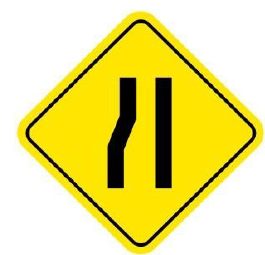
A. Road narrows, left
B. Two-way traffic
C. Divided highway ends
D. Obstruction – keep left
Question 25
This sign indicates:
What does this sign mean?
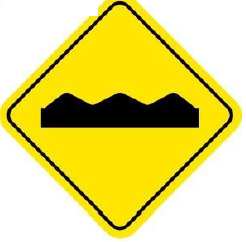
A. Rumble strips
B. Construction zone
C. Bump
D. Pavement ends
Question 26 – Updated 2026
Under Alberta's current GDL rules, what is the shortest probationary period a qualified Class 5-GDL driver may complete if eligible for the maximum 6-month reduction through approved driver training?
According to Alberta's current GDL regulations, if eligible for a maximum six-month reduction through an accredited driver training program, what is the shortest possible Class 5-GDL duration?
A. 6 months
B. 18 months
C. 24 months
D. 12 months
Question 27
A large “X” painted on the pavement indicates:
A large "X" is painted on the road surface to indicate:
A. Construction ahead
B. Traffic lane ending
C. Railway crossing ahead
D. Wild animal crossing ahead
Question 28 – Updated 2026
A collision must be reported to police when someone is injured or killed, or when combined property damage is estimated at:
A collision must be reported to the police if there are injuries, fatalities, or total property damage estimated from:
A. $5,000 or more
B. $2,000 or more
C. $1,000 or more
D. $750 or more
Question 29
When a driver is stopping behind another vehicle in traffic:
When stopping behind another vehicle in a line, the driver should:
A. Remain at least 10 meters behind
B. Allow sufficient space to move into another lane without reversing
C. Apply the 2-second rule
D. Stay approximately 1 meter behind
Question 30
If another vehicle is following too close, what should a driver do?
What should you do if another car is driving too close behind you?
A. Slow down gradually and encourage the vehicle to pass
B. Brake hard
C. Drive 10 km/h above the limit
D. Activate four-way flashers
Question 31
When recovering from a skid, a driver should:
When the vehicle is skidding, the driver should:
A. Accelerate and steer opposite the skid
B. Brake and counter-steer
C. Steer in the direction you want the front of the vehicle to go
D. Brake and hold the steering wheel firmly
Question 32
A slow-moving vehicle sign must be displayed on a vehicle that normally travels at speeds less than:
Slow down signs must be placed behind vehicles that typically travel at lower speeds:
A. 50 km/h
B. 40 km/h
C. 70 km/h
D. 60 km/h
Question 33
A driver attempting to turn left at a steady green traffic light:
The driver wants to turn left at the fixed green light:
A. Has the right-of-way over oncoming traffic
B. Must stop before the crosswalk
C. Has the right-of-way over pedestrians
D. Must not cross the path of an approaching vehicle unless it is safe
Question 34
A “Weave Zone” is best described as:
“The most accurate description of the ”Weave Zone” is:
A. An area where entrance and exit lanes are close together and entering and exiting traffic must cross paths
B. An emergency parking area
C. A highway with several curves
D. An area where reversing is permitted
Question 35
A road test will be refused by a driver examiner if:
The examiner may refuse to allow you to take the road test if:
A. Vehicle seats more than 7 people
B. Vehicle is registered as a farm vehicle
C. Vehicle is a rental
D. Vehicle is not mechanically safe
Question 36
Is a driver allowed to exceed the speed limit when passing another vehicle?
Is a driver allowed to exceed the speed limit when overtaking another vehicle?
A. Only when passing several vehicles
B. Yes, up to 10 km/h over
C. Yes, on primary highways
D. No
Question 37
This sign indicates:
What does this sign mean?
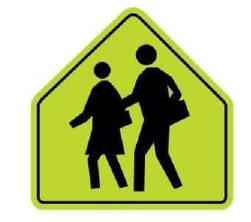
A. Children playing
B. Pedestrian crosswalk ahead
C. School area
D. Playground zone
Question 38
The speed limit in a construction zone must be obeyed:
Speed limits in the construction area must be observed:
A. Only during daylight
B. Only when a flag person is present
C. At all times
D. Only when workers are present
Question 39
In a vehicle without anti-lock brakes, threshold braking refers to:
For vehicles without ABS, "threshold braking" means:
A. Applying braking force just before the wheels lock and ease slightly if they lock
B. Pumping the brake repeatedly
C. Releasing and reapplying until wheels lock
D. Locking the wheels completely
Question 40
When an emergency vehicle sounds a siren approaches on a two-way road, the driver must:
When an emergency vehicle approaches on a two-way road with its siren on, the driver must:
A. Continue at reduced speed
B. Turn on hazard lights
C. Stop only if the emergency vehicle has difficulty passing
D. Move as close as possible to the right curb or edge and stop
Question 41
The recommended braking procedure for a normal, smooth stop is:
The recommended braking method for a smooth stop is:
A. Increase pressure until wheels lock
B. Shift into neutral and brake
C. Pump the brake pedal
D. Apply brake pressure, ease slightly just before stopping, then reapply enough pressure to stop
Question 42
In Alberta, seat belts must be worn:
In Alberta, seat belts must be used:
A. Only when carrying passengers
B. Properly at all times
C. Only at highway speeds
D. Only within cities
Question 43
This sign indicates:
What does this sign mean?
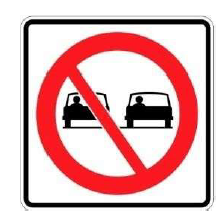
A. Heavy trucks only
B. Do not pass
C. No vehicles allowed
D. Do not enter
Question 44
A driver entering a traffic circle:
Drivers entering a roundabout must:
A. Yield to traffic on the right
B. Yield to vehicles already in the traffic circle
C. Has the right-of-way
D. Yield to the vehicle that arrived first
Question 45
A deceleration lane is:
“"Deceleration lane" is:
A. A lane where vehicles reduce speed when exiting a highway
B. The right lane for slower vehicles
C. A lane beside a solid yellow line
D. A hill lane for slower vehicles
Question 46
When turning left from a two-way road onto a one-way road, what lane should the vehicle enter?
When turning left from a two-way street onto a one-way street, which lane should the vehicle use?
A. The lane nearest the left curb of the one-way road
B. The lane immediately right of center
C. The center lane
D. The right lane
Question 47
When two vehicles approach an uncontrolled “T” intersection at approximately the same time:
When the two vehicles arrived at the T-junction without turn signals almost simultaneously:
A. The vehicle on the left must yield
B. The vehicle on the left has right-of-way
C. The vehicle goes straight always has right-of-way
D. Both vehicles must stop
Question 48
What lane must a driver normally be in to turn left from a one-way road?
When turning left from a one-way street, the driver should typically be in:
A. Lane right of center
B. Left lane nearest the left curb
C. Lane nearest right curb
D. Center lane
Question 49
Which statement describes reversing in a straight line?
Which of the following correctly describes reversing a car in a straight line?
A. Use both hands and rear-view mirror
B. Right hand at top of steering wheel and look over left shoulder
C. Left hand at top of steering wheel and look over right shoulder through rear window
D. Left hand at bottom and use outside mirrors
Question 50
An acceleration lane is:
“"Acceleration lane" is:
A. A lane with broken lines
B. A lane for faster vehicles on hills
C. Left lane used for passing
D. A lane in a merge area used by vehicles entering a highway
Question 51
This sign indicates:
What does this sign mean?
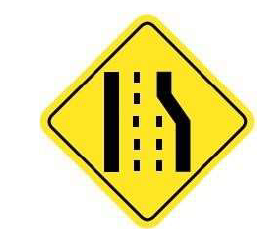
A. Lane ends – loss of right lane
B. Added lane / free flow
C. Curve right
D. Dual turn lane ahead
Question 52
A learner with a Class 7 license is not permitted to drive between:
A person with a Class 7 license is not permitted to drive within the following areas:
A. 9:00 AM – 5:00 PM.
B. Midnight – 5:00 AM.
C. 10:00 PM – 6:00 AM.
Midnight – 7:00 AM.
Question 53
What does a flashing yellow traffic light mean?
What does a flashing yellow light mean?
A. Light will turn green
B. Stop until it stops flashing
C. Light will turn red
D. Proceed with caution
Question 54
Unless otherwise posted, school-zone speed limits are in effect on school days during:
Unless otherwise indicated, school zone speed limits apply on school days within the following ranges:
A. 8:30 AM to one hour after sunset
B. 8:00–9:30 AM, 11:30 AM–1:30 PM, and 3:00–4:30 PM.
C. 8:30–9:30 AM, noon–1:00 PM, 3:30–4:00 PM.
D. 8:00 AM–4:30 PM.
Question 55
This sign indicates:
What does this sign mean?
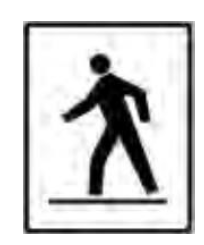
A. Playground zone
B. Pedestrian crosswalk
C. School bus stop
D. School zone
Question 56
When driving in the right lane on a highway and another vehicle attempts to merge from an acceleration lane, you should:
When driving in the right lane on the highway and another vehicle wants to merge from the acceleration lane, you should:
A. Stop
B. Accelerate to close the gap
C. Move left if safe or adjust your speed to merging assist
D. Insist that the merging vehicle yield
Question 57
When parked uphill on a two-way road with a curb, the front wheels should be turned:
When parking on an uphill slope on a two-way street with a shoulder, the front wheels should be turned:
A. Parallel to curb
B. To the left
C. To the right
D. Straight ahead
Question 58
When approaching a stopped school bus with alternating flashing red lights, a driver must:
When approaching a school bus that is stopped and its red lights are flashing alternately, the driver must:
A. Pass slowly
B. Stop and wait until the red lights stop flashing
C. Pass at 30 km/h
D. Stop, check and then pass slowly
Question 59
When traveling in urban areas, drivers should scan the road approximately:
When driving in urban areas, drivers should observe approximately:
A. 25–30 seconds
B. 12–15 seconds
C. 20–30 seconds
D. 1–6 seconds
Question 60
This sign indicates:
What does this sign mean?
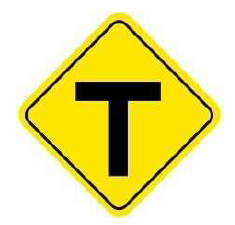
A. T intersection
B. Traffic lane ends
C. Concealed intersection
D. Trucks entering highway
Question 61
This sign indicates:
What does this sign mean?
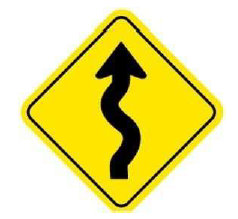
A. Winding road ahead
B. Weave zone ahead
C. Slippery when wet
D. Lane changing permitted
Question 62
Before leaving a parallel parking space on the right side of a road:
Before leaving the parallel parking spot on the right side of the road:
A. Turn on the right signal.
B. Shoulder check to the left
C. Shoulder check to the right
D. Use an arm signal
Question 63
When approaching the top of a hill on a two-lane highway:
As you approach the top of the hill on the two-lane road:
A. You may exceed the speed limit
B. Flash headlights
C. Stay to the right portion of the lane
D. Stay near the center line
Question 64
Playground zones are in effect:
Playground zone is in effect:
A. From 8:30 AM to one hour after sunset
B. 8:00 AM–8:00 PM.
C. During daylight until 11:00 PM.
D. Only around school dismissal times
Question 65
This sign indicates:
What does this sign mean?
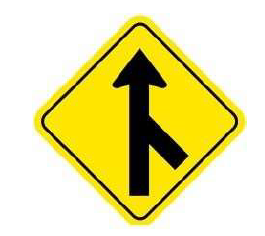
A. T intersection
B. Winding Road
C. Merging traffic
D. Road narrows right
Question 66
According to the Driver's Guide, most skids are the result of:
According to Driver's Guide, most cases of vehicle skidding are due to:
A. Bad brakes
B. Icy roads
C. Bad tires
D. Driver error
Question 67
How close can a driver legally park to a Stop sign?
What is the maximum distance a car is allowed to park near the Stop sign?
A. 10 meters
B. 5 meters
C. 3 metres
D. 1.5 meters
Question 68
Parking in a space reserved for persons with disabilities is permitted:
Parking in a disabled parking space is permitted when:
A. All other spaces are occupied
B. Driver remains in the vehicle
C. Stopping for under 5 minutes
D. Vehicle has a proper identifying placard or license plate
Question 69
At what minimum distance must headlights be dimmed when approaching another vehicle from behind at night?
At night, when approaching another vehicle from behind, you must switch to low beam headlights from a minimum distance:
A. 60 meters
B. 300 meters
C. 150 meters
D. 100 meters
Question 70
When are dual turns permitted at an intersection?
When is it permissible to turn into multiple lanes simultaneously at an intersection?
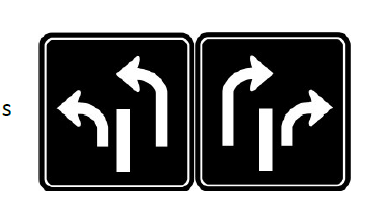
A. Only from one-way to one-way roads
B. Only when indicated by pavement markings or traffic-control signs
C. Whenever there are two lanes
D. Only on roads with six or more lanes
Question 71
This sign indicates:
What does this sign mean?
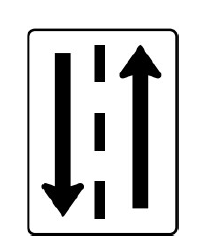
A. Through lane only
B. Passing permitted
C. No turns permitted
D. Two-way traffic
Question 72
A Class 7 learner is suspended when they accumulate:
A person with a Class 7 license will have their license suspended if they accumulate:
A. 15 demerits
B. 12 demerits
C. 8 demonits
D. 7 demonits
Question 73
Speed-limit signs indicate:
The speed limit sign indicates:
A. Speed to travel under all conditions
B. Minimum permitted speed
C. Maximum permitted speed when conditions are favourable
D. Maximum speed except while passing
Question 74
An uncontrolled intersection:
“An "uncontrolled intersection" is a crossroads:
A. With flashing signals
B. With signs but no signal lights
C. With no traffic-control signs or signal lights
D. With Yield signs but no Stop signs
Question 75
This sign indicates:
What does this sign mean?
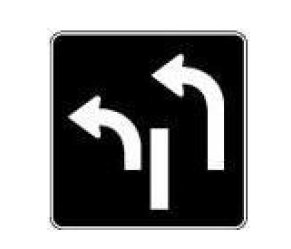
A. Sharp left curve
B. Left turns prohibited
C. Left turn or straight
D. Double-lane left turn
Question 76
When facing a Merge sign, a driver should:
When encountering a Merge sign, drivers should:
A. Stop and wait for a gap
B. Find a gap, adjust to highway speed in the acceleration lane and merge smoothly
C. Stop and yield
D. Reduce speed and proceed
Question 77
In reduced visibility due to fog, smoke or snow, use:
When visibility is reduced due to fog, smoke, or snow, use:
A. Parking lights
B. High beams
C. Low-beam oxides
D. Daytime running lights
Question 78
This sign indicates:
What does this sign mean?
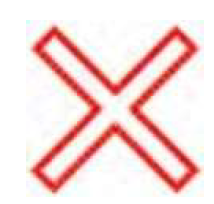
A. Emergency vehicles entering roadway
B. Designated lane closed
C. Railway crossing
D. Do not enter
Question 79
Is a driver allowed to turn right at a red traffic-control light?
Is it permissible to turn right at a red light?
A. Only when a sign permits it
B. Yes, after reducing speed
C. Yes, after stopping, if there is no conflicting traffic, pedestrian or sign prohibiting the turn
D. Never
Question 80
This sign indicates:
What does this sign mean?
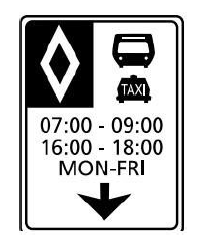
A. Lane reserved for specified vehicles
B. One-way traffic
C. Carpool vehicles only
D. Dangerous-goods vehicles
Question 81
When a vehicle has stopped to allow a pedestrian to cross, vehicles approaching from behind:
When a car has stopped to let a pedestrian cross the road, the cars behind it:
A. May pass if no oncoming traffic
B. Must not pass the stopped vehicle
C. May pass after making eye contact
D. May pass when the signal changes
Question 82
When a head restraint is properly positioned, its center should be:
When the headrest is properly adjusted, the middle section of the headrest should:
A. Be level with the top of the ears
B. Be level with the shoulders
C. Be level with the neck
D. Be level with the top of the head
Question 83
This sign indicates:
What does this sign mean?
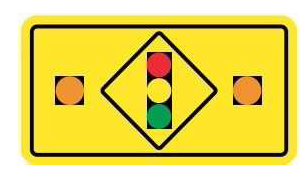
A. School zone ahead
B. Log trucks turning
C. Traffic-control signal advance warning
D. Pedestrian crossing ahead
Question 84
When a “PASSING LANE AHEAD” sign is posted, a slower-moving vehicle should:
When you see the "PASSING LANE AHEAD" sign, slow down and:
A. Reduce speed to half the limit
B. Use left lane only
C. Increasing speed
D. Move into the right lane when safe
Question 85
When approaching a school bus alternating displaying flashing amber lights, a driver should:
When approaching a school bus with its yellow lights flashing alternately, the driver should:
A. Be prepared to stop because the red lights may activate once the bus stops
B. Assume there is a collision
C. Stop immediately
D. Assume the bus is approaching railway tracks
Question 86
“Nighttime” is defined in the Driver's Guide as:
According to Driver's Guide, "nighttime" is defined as:
A. One hour before sunset to one hour after sunrise
B. Sunset to sunrise
C. 7 PM–7 AM.
D. One hour after sunset to one hour before sunrise
Question 87
This sign indicates:
What does this sign mean?
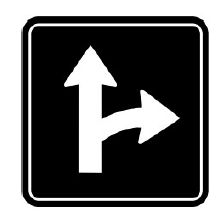
A. No through traffic or right turns
B. Turn left or straight
C. Turn from one one-way road to another
D. Straight through or right turn
Question 88
A vehicle exiting a parking lot onto a roadway:
The car is driving out of the parking lot onto the road:
A. Stops only if there is a Stop sign
B. Must come to a complete stop
C. Stops only if pedestrians are present
D. Is not required to stop
Question 89
When approaching a railway crossing with flashing red lights and bell activated:
When approaching the railway, the red light is flashing and the bell is ringing:
A. Cross if train is 250 meters away
B. Slow down and proceed
C. Do not stop
D. Stop at least 5 meters from the nearest rail until the train has passed
Question 90
The recommended method for traveling through a curve on a highway is:
The recommended way to navigate the curve on the highway is:
A. Reduce speed before the curve, remain in your lane and gently accelerate after entering the curve
B. Brake while in the curve
C. Counter-steer toward outside
D. Accelerate before entering
Question 91
This sign indicates:
What does this sign mean?
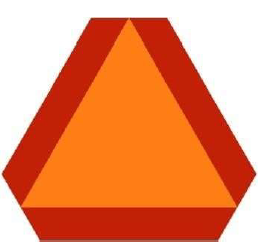
A. Yield to pedestrians and traffic
B. Flammable gas placard
C. Slow-moving vehicle
D. Yield sign ahead
Question 92
Why is it unsafe to pass a loaded log-haul truck that is turning?
Why is it unsafe to overtake a logging truck that is turning?
A. Truck driver must concentrate on turning
B. Loaded log trucks use a six-second rule
C. The overhanging logs can create a danger zone and block lanes during the turn
D. It is always illegal
Question 93
This sign indicates:
What does this sign mean?
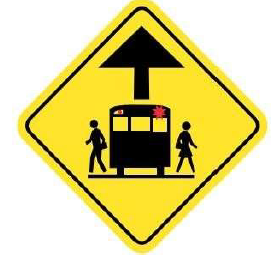
A. Playground zone ahead
B. Pedestrian crossing ahead
C. School bus stop ahead
D. School zone ahead
Question 94
When encountering a funeral procession crossing an intersection:
When encountering a funeral procession crossing the intersection:
A. Sound the horn
B. Drive through a gap
C. Yield and do not break through the process
D. Flash high beams
Question 95
If the vehicle's right tires leave the paved portion of the roadway:
If the right wheel goes off the paved road:
A. Brake and counter-steer immediately
B. Keep a firm grip, ease off the accelerator, then gradually return to the roadway
C. Accelerate and turn sharply
D. Drive completely off the road first
Question 96
This sign indicates:
What does this sign mean?
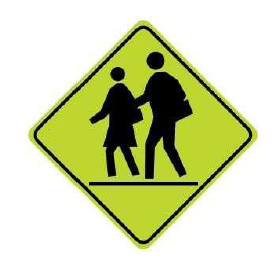
A. School zone
B. School crosswalk ahead
C. Playground zone
D. Pedestrian-activated lights ahead
Question 97
When completing an corner park, the vehicle's front wheel should be within what maximum distance from the nearest curb?
When cornering, the front wheels of the vehicle must be as close as possible to the nearest curb:
A. 100 cm
B. 50 cm
C. 25 cm
D. 75 cm
Question 98
In an urban area, when a pedestrian at a crosswalk raises an arm at approximately a right angle and points toward the opposite curb, what does it mean?
In urban areas, when pedestrians at a crosswalk raise their arms at a right angle and point towards the opposite curb, it means:
A. Drivers must stop and yield to the pedestrian
B. The pedestrian is visually impaired
C. Drivers do not need to yield until the pedestrian steps off the curb
D. Drivers should pass at 20 km/h
Question 99
This sign indicates:
What does this sign mean?
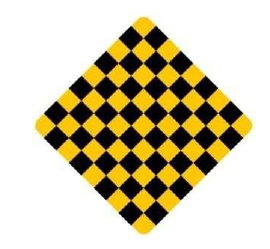
A. Pavement ends
B. Construction zone ahead
C. Dead end
D. Hazard marker
Question 100
This sign indicates:
What does this sign mean?
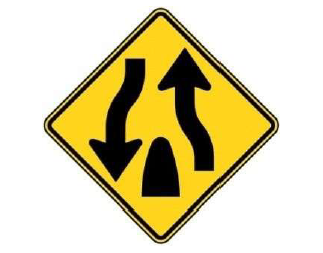
A. Divided highway ends
B. Divided highway begins
C. Obstruction – pass on left
D. Two-way traffic
Question 101
When approaching an intersection displaying a steady yellow traffic light:
When approaching an intersection with a fixed yellow traffic light:
A. Proceed because it will turn green
B. Yield to vehicles on the right
C. Stop before the intersection unless stopping cannot be done safely
D. Increase speed
Question 102
A solid yellow line together with a broken yellow line in the center of a highway means:
A solid yellow line and a broken yellow line in the middle of the road mean:
A. Road narrows ahead
B. Passing permitted when solid line is on your side
C. Passing prohibition when broken line is on your side
D. If the broken line is on your side, passing is permitted when safe
Question 103
At 9:00 AM on a school day, what is the maximum speed in a rural school zone unless otherwise posted?
At 9 a.m. on a school day, what is the maximum speed limit in a rural school zone unless otherwise indicated by signs?
A. 50 km/h
B. 20 km/h
C. 40 km/h
D. 30 km/h
Question 104
On a two-lane highway, when passing a vehicle traveling in the same direction, a driver:
On a two-lane highway, when overtaking a vehicle traveling in the same direction, the driver should:
A. Should pass on the left when safe
B. Should pass on the right
C. Should travel 30 km/h faster
D. Should wait until within 3 meters before passing
Question 105
This sign indicates:
What does this sign mean?
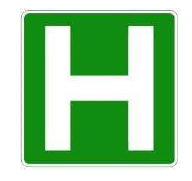
A. Off-road facilities
B. Hospital services
C. Hotel services
D. Primary highway route marker
Question 106
What minimum distance from a fire hydrant must a vehicle be parked?
What is the minimum distance a vehicle must be parked from a fire hydrant?
A. 3 meters
B. 4 meters
C. 2 meters
D. 5 meters
Question 107
This sign indicates:
What does this sign mean?
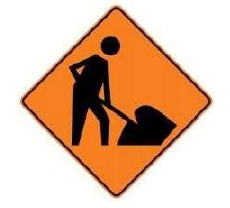
A. Construction – flag person ahead
B. Construction – detour ahead
C. Falling rock ahead
D. Construction – people working ahead
Question 108
If a driver is being followed by a vehicle attempting to pass on a two-way road, the driver should:
If a vehicle behind you is trying to overtake you on a two-way street, you should:
A. Move toward the left side of your lane
B. Stay in your lane and move toward the right portion of the lane
C. Turn on the left signal
D. Turn on the right signal and drive in the parking lane
Answer Key for 108 Practice Questions for Class 7 Alberta
- A
- C
- C
- A
- A
- B
- D
- C
- C
- A
- C
- D
- A
- A
- C
- A
- C
- C
- C
- C
- D
- D
- B
- A
- C
- B – 18 months (updated 2026)
- C
- A – $5,000 or more (updated 2026)
- B
- A
- C
- B
- D
- A
- D
- D
- C
- C
- A
- D
- D
- B
- B
- B
- A
- B
- A
- B
- C
- D
- A
- B
- D
- B
- B
- C
- B
- B
- B
- A
- A
- B
- C
- A
- C
- D
- B
- D
- C
- B
- D
- C
- C
- C
- D
- B
- C
- C
- C
- A
- B
- A
- C
- D
- A
- D
- D
- B
- D
- A
- C
- C
- C
- C
- B
- B
- B
- A
- C
- A
- C
- D
- D
- A
- B
- D
- D
- B
How many points did you get?
You can check your results yourself after completing all 108 questions:
- 95–108 correct answers: Excellent! Your knowledge is quite solid.
- 80–94 correct answers: Good! Let's review some traffic signs and rules.
- 65–79 correct answers: You're on the right track, but you should practice more.
- Under 65 sentences: You should reread the Alberta Driver's Guide and continue practicing the exercises.
In the actual Grade 7 exam, you don't need to answer 108 questions. The Knowledge Test consists of... There are 30 multiple-choice questions, and you need to get at least 25 correct to pass..
Important Note
The above set of questions was compiled in order to Support for reviewing and preparing for the Class 7 Alberta exam., These are not official questions and there is no guarantee that they will appear in the actual exam.
Traffic laws and driver's license regulations in Alberta may be updated. Learners should take note. Alberta Driver's Guide: Cars and Light Trucks and information from Government of Alberta as the official source of reference.
Good luck with your studies and I hope you pass your Class 7 Alberta exam soon!